Sample the Album
When you think about the world of down and dirty classic punk, you think of bands like The Sex Pistols, The Ramones, Patti Smith, The Buzzcocks, The Cramps, The Slits, The Clash, Iggy and the Stooges and so on. You don't necessarily think of Siouxsie and the Banshees. Siouxsie Sioux is usually pegged as the dark princess of theatrical goth rock (with a fingernail constantly swirling in post-punk), a label with total and undeniable merit. That is, except for her very first record, The Scream.
Before Siouxsie and company started ordering black eye-shadow and high-volume hair products in bulk, they were part of the sweaty and exciting punk scene of mid-to-late '70s England. Most of Siouxsie and the Banshees' early output is extremely direct, rapid and snarling - there are only a few leanings into the crazed, garish twilight they would later come to embody. After breaking out with their hit single, "Hong Kong Garden", the band's early efforts would culminate on The Scream in 1978, a vividly ferocious debut album that personifies everything I've come to love about punk rock and NONE of what I hate about it.
For me, The Scream is more than just an album. The Scream is a tangible summation of the grit and irreverence that punk music had initially promised. It's all deep red madness with golden smoke around it. Listening to it unfold is like watching a hulking, feminine tiger stalk it's prey, gore it to pieces and then chew sumptuously on the entrails. The album opens with a primal chant ("Pure"), in which Siouxsie and her band mates exchange revelrous moans, overshadowed by a heavy and slowly recurring bass tone. The intentions have been made clear - you're entering the hunting grounds. The band kicks up immediately with "Jigsaw Feeling", a hot red set of needles that tear into the skull, all the while Siouxsie announcing an inevitable mental deterioration, "One day I'm feeling total/the next I'm split in two/my eyes are doing somersaults/staring at my shoes".
"Overground" maintains the animalistic nature of the album, but it's in a more measured, brooding fashion. The guitar stalks slow and alone in the intro, only joined by Siouxsie's shrill confidence and a booming set of tribal drums halfway into the song. It's followed up with an inverted cover of "Helter Skelter" by The Beatles, which completely obliterates the original in terms of pure satisfaction and delivery. The band's version emerges out of the darkness, scattered bass notes and guitar screeches giving way to ragged energy. Siouxsie infuses the cyclical lyrics with an obstinate charm, like she's toying with her prey. She adds a very well placed swear, in the line "You might be a lover, but you ain't no fucking dancer", which pretty much trademarks the song solely for the band at that point in time.
There's a welcoming give-and-take when it comes to tempo changes across the album. Each song is basically a refresher for the last, giving The Scream infinite propulsion - you could literally listen to it back to back to back to back and never really tire of the succinct punk contained within. "Metal Postcard", with it's deranged bird-call guitar slides and the jittering chords of "Nicotine Stain" are another great example of this slow-to-fast alternation. "Metal Postcard" provides the punch, while "Nicotine Stain" provides the vigor.
Of course, it's Siouxsie Sioux's proud and defiant style that pulls everything through the looking glass. Her cautionary tales, examinations of human nature and all-out celebrations of the depraved push the nocturnal punk of The Scream into the territory of "unforgettable". She has this way of weaving evocative lyrics without handing everything over in exposition, sliding her vocals up or down as they hang on particular words. Passages such as "By hook or by crook/you'll be the first in his book/for an impaled affair" and "out of the frying pan/and into the fire/58th variety" on "Carcass" paint the imminent doom of some unlucky victim with just enough vivid description for you to fill in the spaces. On "Mirage", Siouxsie sings about the flat, relatively meaningless existence of sexual spectacle, particularly on TV, "I'm just a vision on your TV screen/just something captured from a dream", moving on to acutely describe the controlling nature of the spectator, "my limbs are like palm trees/swaying in the breeze/my body's an oasis/to drink from as you please".
When all is said and done, I feel that The Scream is so ferociously definitive that I'm glad the band (and it's rotating roster of musicians) went on to explore other arenas of music. Siouxsie and the Banshees could easily have burned out by clinging to their punk roots and producing some tired, sub-par albums along the way. Instead, they chose to evolve. The band didn't have a perfect track record thereafter, but their whirlwind career produced several fantastic records. The Scream is one of those records, and in my opinion, their very best. You can't tame it's animal style, and really, who the fuck would want to?
Thursday, March 8, 2012
Thursday, February 23, 2012
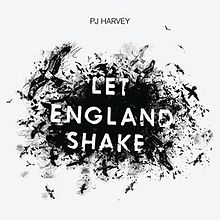
PJ Harvey - Let England Shake
Sample the Album
I have had a long-time crush on PJ Harvey and her music. In fact, once I get started, it's hard for me to shut the fuck up about how wonderful she is. The reasons PJ sits high, like a dominant queen, on my list of favorite artists are numerous: she's a raven-haired slink, a sexy cool lady with a huge mouth and a siren-call voice to match it, her equally self-effacing and empowered lyrics pull no punches, her employment of chunky guitar chords that constantly fold in on themselves is addictive, her shift from punk to blues to spindly folk is effortless, her everything, everything, everything.
It's not to say, in actuality, she's perfect and I just gobble up anything she dishes out, however. I've never quite understood the major wank-fest behind her third album, To Bring You My Love, an odyssey into an unscrupulous jazz/blues hybridization - all with a bit of dirty electronica thrown in to little avail. "Meet Za Monsta" is an interesting song, but it's not enough to save the experience. I've had similar feelings when listening to Harvey's work with John Parish. There's just not enough satisfaction in the songs or the concept, not enough pure PJ for my tastes.
So PJ can certainly do wrong in my precious ears, but it ain't likely. Her latest album, Let England Shake, ain't too wrong at all. It's a simultaneous send-up, sorrowful critique and love letter written to her homeland and, in particular, its troubled history. The album sounds like you are traversing the halls of an extravagant palace - the constant, echoing guitar like pristine white marble strewn across and throughout. Harvey is the downtrodden, wilting countess, showing you around sun-soaked courtyards and stately, gold-fringed rooms to paintings of England's proud loves, shamed atrocities, gorgeous landscapes and fervent loyalties. It's a distinct mixture of beauty and disgrace, and ultimately new political territory for Harvey to tread.
On the brass-punctuated, "The Last Living Rose", Harvey sings out matter-of-factly, "god damn Europeans/take me back to beautiful England", then goes on to describe her country with both wit and morbid effervescence, "and the grey, damp filthiness of ages/and battered books and/fog rolling down behind the mountains/on the graveyards and dead sea captains". Set to a translucent, rolling guitar strum, she mourns the terrors of war on "The Words that Maketh Murder", in the high-pitched moan she first adopted on White Chalk, singing, "I've seen and done things I want to forget/I've seen soldiers fall like lumps of meat" and "coming from an unearthly place/longing to see a woman's face/instead of the words that gather pace/the words that maketh murder".
Let England Shake is full of brutal irony and earnest misery, but Harvey does her best to keep things flowing, mainly by turning her history lessons into live demonstrations. The flow does taper a bit in the middle, especially during "On Battleship Hill" and "England", however, PJ's got a cure waiting around the corner with the intense guitar slide of "Bitter Branches" and the delicate piano ballad, "Hanging in the Wire".
Let England Shake is something that is obviously near and dear to Harvey. In an interview, she claimed that until recently she had never been confident enough to write politics and history into her lyrics, but had always wanted to. Perhaps now that she is older and has vented many of her past proximal demons, her liberation is complete. However, the evolution from deeply personal, raw narratives to expansive folk songs is definitely a major shift. Those who stick firmly to her ragged blue soul may find the album pretentious and beyond scope, but those who are willing to ride along on her artistic journey can find a lot to love about Let England Shake.
I have had a long-time crush on PJ Harvey and her music. In fact, once I get started, it's hard for me to shut the fuck up about how wonderful she is. The reasons PJ sits high, like a dominant queen, on my list of favorite artists are numerous: she's a raven-haired slink, a sexy cool lady with a huge mouth and a siren-call voice to match it, her equally self-effacing and empowered lyrics pull no punches, her employment of chunky guitar chords that constantly fold in on themselves is addictive, her shift from punk to blues to spindly folk is effortless, her everything, everything, everything.
It's not to say, in actuality, she's perfect and I just gobble up anything she dishes out, however. I've never quite understood the major wank-fest behind her third album, To Bring You My Love, an odyssey into an unscrupulous jazz/blues hybridization - all with a bit of dirty electronica thrown in to little avail. "Meet Za Monsta" is an interesting song, but it's not enough to save the experience. I've had similar feelings when listening to Harvey's work with John Parish. There's just not enough satisfaction in the songs or the concept, not enough pure PJ for my tastes.
So PJ can certainly do wrong in my precious ears, but it ain't likely. Her latest album, Let England Shake, ain't too wrong at all. It's a simultaneous send-up, sorrowful critique and love letter written to her homeland and, in particular, its troubled history. The album sounds like you are traversing the halls of an extravagant palace - the constant, echoing guitar like pristine white marble strewn across and throughout. Harvey is the downtrodden, wilting countess, showing you around sun-soaked courtyards and stately, gold-fringed rooms to paintings of England's proud loves, shamed atrocities, gorgeous landscapes and fervent loyalties. It's a distinct mixture of beauty and disgrace, and ultimately new political territory for Harvey to tread.
On the brass-punctuated, "The Last Living Rose", Harvey sings out matter-of-factly, "god damn Europeans/take me back to beautiful England", then goes on to describe her country with both wit and morbid effervescence, "and the grey, damp filthiness of ages/and battered books and/fog rolling down behind the mountains/on the graveyards and dead sea captains". Set to a translucent, rolling guitar strum, she mourns the terrors of war on "The Words that Maketh Murder", in the high-pitched moan she first adopted on White Chalk, singing, "I've seen and done things I want to forget/I've seen soldiers fall like lumps of meat" and "coming from an unearthly place/longing to see a woman's face/instead of the words that gather pace/the words that maketh murder".
Let England Shake is full of brutal irony and earnest misery, but Harvey does her best to keep things flowing, mainly by turning her history lessons into live demonstrations. The flow does taper a bit in the middle, especially during "On Battleship Hill" and "England", however, PJ's got a cure waiting around the corner with the intense guitar slide of "Bitter Branches" and the delicate piano ballad, "Hanging in the Wire".
Let England Shake is something that is obviously near and dear to Harvey. In an interview, she claimed that until recently she had never been confident enough to write politics and history into her lyrics, but had always wanted to. Perhaps now that she is older and has vented many of her past proximal demons, her liberation is complete. However, the evolution from deeply personal, raw narratives to expansive folk songs is definitely a major shift. Those who stick firmly to her ragged blue soul may find the album pretentious and beyond scope, but those who are willing to ride along on her artistic journey can find a lot to love about Let England Shake.
Friday, February 17, 2012
Charlotte Gainsbourg - Stage Whisper
Sample the Album
Although Charlotte Gainsbourg has increasingly embraced the world of acting in recent years, she still finds time to reconnect with her showbiz roots and, subsequently, cuts a fresh music album here and there. Gainsbourg isn't necessarily the brains behind these endeavors, but she does apply her trademark hush-tones to music orchestrated and arranged by more indie rock stars than you can shake a bag of glass at, including Jarvis Cocker, Air and Beck.
Her latest album, Stage Whisper, is actually left overs from her previous record, IRM, which was largely the baby of Mr. Two Turn-Tables himself. It's particularly ironic in my mind, because I felt the material on IRM was uninspired, sloppy and too crazy grab-bag eclectic for its own good. Stage Whisper seems much more concise and in control of it's destiny - almost as if someone grabbed Beck by the shoulders and said, "STOP IT", loudly, right into his deadpan face.
Stage Whisper has far more stark definition to it, roaming from burning midnight discotheques to old, crumbling ballet and opera halls full of reverb. Gone is the lackadaisical baroque electronica of IRM, and in comes its darker, bittersweet sister. I would actually even go so far as to compare this "odds and ends are better than the prime cuts" idea to Radiohead's Kid A and Amnesiac. Most folks tend to get all rah-rah for Kid A automatically, but I've always found myself drawn closer to the trickled down bits of Amnesiac. It's definitely not as cohesive as its better-received comrade, but there is this exciting, palpable disjointedness that makes the album so much more interesting. So, while Stage Whisper may be full of second-string rejects, the underdog factor prevails, and the album is far more of a triumph.
You don't need to sweep your flashlight down the album's darkened ballet halls for long to discover irresistible trinkets like "Terrible Angels" with it's grimy pulsations and the nocturnal, inverted funk of "Paradisco". "All the Rain" tosses in some reverbed drums and ambient synthesizers, Gainsbourg's mouse-like delivery simultaneously providing a strange comfort and disturbance, like a bi-polar ghost, forever haunting decrepit passageways and stairwells of a once beautiful venue.
Of course, when the first chiming tones of "Got to Let Go" march into your ears, then you know you've discovered the long lost heart of the old hall. The luminous white-lit space of the song is a portal directly to the deeply felt rigors of remorse and acceptance. Gainbourg laments delicately, "you've got to be strong when they call it a day/got to realize when there's nothing left to say," then quietly dissolves with a wavering resignation, "good things come and go/one day you will know/you've got to let go". These aren't particularly deep lyrics but there is a profundity and smiling sense of loss to be found - the way the '80s keys tap along, the tight, echoed drum machine snaps and the singer's vibrantly diminutive vocals coalesce - there is real love in this song. Add to it a striking duet with singer Charles Fink, and you've got a fantastic little number dedicated to the heartbroken, the scorned, the neglected, the weary and everything in between.
I'd say the only thing this very solid album suffers from is a short track-listing. There are only 8 previously unreleased tracks on the album, the rest consists of throw-away live performances and remixes. You'll find that the proper portion of Stage Whisper is gone within a few short breaths and few flutters of the eyelashes. But the impact remains. The ghost has passed through you, in all of her make-shift tragedy and though she may never be at the forefront of your passions, she will always be around when you need her.
Although Charlotte Gainsbourg has increasingly embraced the world of acting in recent years, she still finds time to reconnect with her showbiz roots and, subsequently, cuts a fresh music album here and there. Gainsbourg isn't necessarily the brains behind these endeavors, but she does apply her trademark hush-tones to music orchestrated and arranged by more indie rock stars than you can shake a bag of glass at, including Jarvis Cocker, Air and Beck.
Her latest album, Stage Whisper, is actually left overs from her previous record, IRM, which was largely the baby of Mr. Two Turn-Tables himself. It's particularly ironic in my mind, because I felt the material on IRM was uninspired, sloppy and too crazy grab-bag eclectic for its own good. Stage Whisper seems much more concise and in control of it's destiny - almost as if someone grabbed Beck by the shoulders and said, "STOP IT", loudly, right into his deadpan face.
Stage Whisper has far more stark definition to it, roaming from burning midnight discotheques to old, crumbling ballet and opera halls full of reverb. Gone is the lackadaisical baroque electronica of IRM, and in comes its darker, bittersweet sister. I would actually even go so far as to compare this "odds and ends are better than the prime cuts" idea to Radiohead's Kid A and Amnesiac. Most folks tend to get all rah-rah for Kid A automatically, but I've always found myself drawn closer to the trickled down bits of Amnesiac. It's definitely not as cohesive as its better-received comrade, but there is this exciting, palpable disjointedness that makes the album so much more interesting. So, while Stage Whisper may be full of second-string rejects, the underdog factor prevails, and the album is far more of a triumph.
You don't need to sweep your flashlight down the album's darkened ballet halls for long to discover irresistible trinkets like "Terrible Angels" with it's grimy pulsations and the nocturnal, inverted funk of "Paradisco". "All the Rain" tosses in some reverbed drums and ambient synthesizers, Gainsbourg's mouse-like delivery simultaneously providing a strange comfort and disturbance, like a bi-polar ghost, forever haunting decrepit passageways and stairwells of a once beautiful venue.
Of course, when the first chiming tones of "Got to Let Go" march into your ears, then you know you've discovered the long lost heart of the old hall. The luminous white-lit space of the song is a portal directly to the deeply felt rigors of remorse and acceptance. Gainbourg laments delicately, "you've got to be strong when they call it a day/got to realize when there's nothing left to say," then quietly dissolves with a wavering resignation, "good things come and go/one day you will know/you've got to let go". These aren't particularly deep lyrics but there is a profundity and smiling sense of loss to be found - the way the '80s keys tap along, the tight, echoed drum machine snaps and the singer's vibrantly diminutive vocals coalesce - there is real love in this song. Add to it a striking duet with singer Charles Fink, and you've got a fantastic little number dedicated to the heartbroken, the scorned, the neglected, the weary and everything in between.
I'd say the only thing this very solid album suffers from is a short track-listing. There are only 8 previously unreleased tracks on the album, the rest consists of throw-away live performances and remixes. You'll find that the proper portion of Stage Whisper is gone within a few short breaths and few flutters of the eyelashes. But the impact remains. The ghost has passed through you, in all of her make-shift tragedy and though she may never be at the forefront of your passions, she will always be around when you need her.
Tuesday, January 17, 2012
The Clash - London Calling
Sample the Album
The Clash are one of those bands that most folks are railroaded into appreciating, kind of like The Beatles or Nirvana or David Bowie, because of the cultural impact they had on music during their heyday. Critics and fans alike beat you senseless with bludgeons of melodramatic praise and sometimes you can't help but blindly agree as their irrational (or skewed) energy seeps into your brain. I think it's fair to recognize (and respect) the significance such bands have drawn in the history of pop music, but I don't think people should confuse "respect" with "enjoyment".
So it is with The Clash, a band I certainly respect but cannot say I enjoy on any consistent level. People are always quick to point to their album, London Calling, as the band's definitive statement to the world. I remember buying the album strictly because of its reputation when I was in high school. I had the "if critics like it, then I should too" mentality going on strong back then. However, upon listening to the much-lauded record, I discovered a lot of inconsistency, as if all the songs didn't make much sense together, but might have been better off spaced across several albums, each dedicated exclusively to a chosen style. As it stands, the album is really just a series of anomalies.
"London Calling" isn't a terrible opener, with it's pulsating guitar chords and playful bass line, but it doesn't have the gravity that Joe Strummer clearly thinks it does. He groans out a series of implicit, rally-cry phrases like "Phony Beatlemania has bitten the dust", "London calling to the zombies of death/quit holdin' out as I draw another breath" and, of course, "London has drowned, and I live by the river". It's a song that critiques consumerism and the stifling of world awareness, but the midnight-punk music lacks enough power to hold it all up.
"London Calling" is followed closely by excursions into surf ("Brand New Cadillac"), lounge-lizard ska ("Jimmy Jazz") and straight-up reggae ("Rudie Can't Fail"). This is a jostling rotation of styles that conjures a feeling of uneasy disconnection. You almost already feel exhausted as The Clash sing "Rudie can't faaaailll" over and over at the close of the first chunk of the record. Then, in comes "Spanish Bombs" to knock your socks off in the right direction. The easy-going lead guitar is a hunky '50s pin-up, filled out by a quick and cautious drum beat. This bubblegum sound ironically frames the ultra political words by Strummer, where he teaches a violent history lesson. The song has this gratifying poignancy to it, thanks to the intersection of sweet melodies and horrendous lyrical imagery.
And the album seems to follow suit from there, a collection of strange influence-infused explorations that would become hallmarks for The Clash down the line, as well as tried and true punk rock anthems that jettisons the blood through your veins. London Calling sounds like a small old cigar box you'd discover by chance in someone's closet. The box would contain old war metals, pamphlets on radical liberalism, pictures of sun-burned vistas and grungy slums from far off places, pictures of old friends, lovers, pimps and thieves - and probably some leftover weed. It's a box that's interesting, but ultimately too jumbled to care about as a whole.
It's an odd sensation holding on to London Calling for so long. It's an album too sloppy to really get your hands around and too intriguing to get rid of. You feel the intensity in all of the songs, but the energy is too scatter-shot to be completely enjoyable. Palpable and righteous songs like "Clampdown" and "Train in Vain" are a perfect fit for the anthem rock archetype of The Clash, but at other times, such as the low-down reggae of "The Guns of Brixton", you can't help but feel how silly and ponderous they are. I can give credit to the band for stepping out of their tattered punk rock sneakers to throw a no-holds-barred soiree of world music, but when the overall direction isn't magnified, you're left with a bunch of good songs meant to be heard on a dozen different albums.
The Clash are one of those bands that most folks are railroaded into appreciating, kind of like The Beatles or Nirvana or David Bowie, because of the cultural impact they had on music during their heyday. Critics and fans alike beat you senseless with bludgeons of melodramatic praise and sometimes you can't help but blindly agree as their irrational (or skewed) energy seeps into your brain. I think it's fair to recognize (and respect) the significance such bands have drawn in the history of pop music, but I don't think people should confuse "respect" with "enjoyment".
So it is with The Clash, a band I certainly respect but cannot say I enjoy on any consistent level. People are always quick to point to their album, London Calling, as the band's definitive statement to the world. I remember buying the album strictly because of its reputation when I was in high school. I had the "if critics like it, then I should too" mentality going on strong back then. However, upon listening to the much-lauded record, I discovered a lot of inconsistency, as if all the songs didn't make much sense together, but might have been better off spaced across several albums, each dedicated exclusively to a chosen style. As it stands, the album is really just a series of anomalies.
"London Calling" isn't a terrible opener, with it's pulsating guitar chords and playful bass line, but it doesn't have the gravity that Joe Strummer clearly thinks it does. He groans out a series of implicit, rally-cry phrases like "Phony Beatlemania has bitten the dust", "London calling to the zombies of death/quit holdin' out as I draw another breath" and, of course, "London has drowned, and I live by the river". It's a song that critiques consumerism and the stifling of world awareness, but the midnight-punk music lacks enough power to hold it all up.
"London Calling" is followed closely by excursions into surf ("Brand New Cadillac"), lounge-lizard ska ("Jimmy Jazz") and straight-up reggae ("Rudie Can't Fail"). This is a jostling rotation of styles that conjures a feeling of uneasy disconnection. You almost already feel exhausted as The Clash sing "Rudie can't faaaailll" over and over at the close of the first chunk of the record. Then, in comes "Spanish Bombs" to knock your socks off in the right direction. The easy-going lead guitar is a hunky '50s pin-up, filled out by a quick and cautious drum beat. This bubblegum sound ironically frames the ultra political words by Strummer, where he teaches a violent history lesson. The song has this gratifying poignancy to it, thanks to the intersection of sweet melodies and horrendous lyrical imagery.
And the album seems to follow suit from there, a collection of strange influence-infused explorations that would become hallmarks for The Clash down the line, as well as tried and true punk rock anthems that jettisons the blood through your veins. London Calling sounds like a small old cigar box you'd discover by chance in someone's closet. The box would contain old war metals, pamphlets on radical liberalism, pictures of sun-burned vistas and grungy slums from far off places, pictures of old friends, lovers, pimps and thieves - and probably some leftover weed. It's a box that's interesting, but ultimately too jumbled to care about as a whole.
It's an odd sensation holding on to London Calling for so long. It's an album too sloppy to really get your hands around and too intriguing to get rid of. You feel the intensity in all of the songs, but the energy is too scatter-shot to be completely enjoyable. Palpable and righteous songs like "Clampdown" and "Train in Vain" are a perfect fit for the anthem rock archetype of The Clash, but at other times, such as the low-down reggae of "The Guns of Brixton", you can't help but feel how silly and ponderous they are. I can give credit to the band for stepping out of their tattered punk rock sneakers to throw a no-holds-barred soiree of world music, but when the overall direction isn't magnified, you're left with a bunch of good songs meant to be heard on a dozen different albums.
Wednesday, January 11, 2012
Love Inks - E.S.P.
Sample the Album
On the surface, Love Inks' debut album, E.S.P. sounds a bit like a hipster dreaming of a girl-angel caught in a box. The Austin, Texas-based band employs that forward-moving chug of bass and oscillating guitar that has become synonymous with most indie pop and rock acts of the last 11 years. It's not necessarily an aesthetic that is devoid of value just because it saturates the market, but then again, it makes distinction an elusive attribute to obtain. It was only upon full listening that I discovered Love Inks actually do have the goods.
Stripping their sound down to guitar, bass and an analog drum machine, the band stand tall in the face of fashionable reverb and delay. The ambience in their music comes not from a layered wall of sound, but from the empty, hollowed space that stretches above them. "Blackeye" is a pristine example - it's a song that ushers you into a lovelorn diner at 3 in the morning. The mood is set by a gentle cycle of guitar notes and a consistent swish of drums. The soft-sold delivery of singer Sherry LeBlanc comes off like an inquisitive but compassionate waitress, "you've got a black eye on your eye/tell me was it from a fight" and the chorus, "did it happen last night?".
Throughout E.S.P., LeBlanc offers a lot of simple, repetitious lyrics with slight twists into cheek. It's a handy device that stems the tides of gushy sentiment and nostalgia. Instead, the album feels like a bunch of enigmatic stories told during a twilight drive across the Southwestern United States. You, naturally, are the driver, while LeBlanc mutters yarns on love, pain, indecision and surrealism in the passenger seat. The other band members sit in back, lazily strumming their instruments in time, making your moonbeam journey a gentle success.
However, E.S.P. isn't perfect and Love Inks find themselves taking two slight detours over the course of their 10 song set list. "Can't Be Wrong" and "Skeleton Key" push the album into more generic territory, with the chunk-flop shift of the bass in "Can't Be Wrong" and the spaced out chords of "Skeleton Key" evoking bands that you and I have heard over and over and over and over. It's a marked disappointment that effectively breaks up the flow of the album, like a shallow pothole surrounded by gleaming asphalt.
Despite this, I feel Love Inks carve out their quiet fire in a thoughtful and consequential way. E.S.P. isn't immaculate but it does point to a band looking to claw their way out of easy trends and shallow expectations. All of this, while retaining a style that they are passionate about and that accurately synthesizes the bright corners of their influences. Personally, I love the idea of a band embracing minimal music arrangement and still coming off as ethereal. It's a breath of fresh air in a market that is dominated by obligatory '80s synthesizers, cascades of delayed guitar lines, noise crescendos galore and humdrum female stand-ins. Love Inks may be lumped in with the recent rash of candy-coated girl bands, such as the mind-numbingly dull Dum Dum Girls, but it's important to not be fooled by lazy critics and publications (basically all of them), Love Inks have a potential all of their own.
On the surface, Love Inks' debut album, E.S.P. sounds a bit like a hipster dreaming of a girl-angel caught in a box. The Austin, Texas-based band employs that forward-moving chug of bass and oscillating guitar that has become synonymous with most indie pop and rock acts of the last 11 years. It's not necessarily an aesthetic that is devoid of value just because it saturates the market, but then again, it makes distinction an elusive attribute to obtain. It was only upon full listening that I discovered Love Inks actually do have the goods.
Stripping their sound down to guitar, bass and an analog drum machine, the band stand tall in the face of fashionable reverb and delay. The ambience in their music comes not from a layered wall of sound, but from the empty, hollowed space that stretches above them. "Blackeye" is a pristine example - it's a song that ushers you into a lovelorn diner at 3 in the morning. The mood is set by a gentle cycle of guitar notes and a consistent swish of drums. The soft-sold delivery of singer Sherry LeBlanc comes off like an inquisitive but compassionate waitress, "you've got a black eye on your eye/tell me was it from a fight" and the chorus, "did it happen last night?".
Throughout E.S.P., LeBlanc offers a lot of simple, repetitious lyrics with slight twists into cheek. It's a handy device that stems the tides of gushy sentiment and nostalgia. Instead, the album feels like a bunch of enigmatic stories told during a twilight drive across the Southwestern United States. You, naturally, are the driver, while LeBlanc mutters yarns on love, pain, indecision and surrealism in the passenger seat. The other band members sit in back, lazily strumming their instruments in time, making your moonbeam journey a gentle success.
However, E.S.P. isn't perfect and Love Inks find themselves taking two slight detours over the course of their 10 song set list. "Can't Be Wrong" and "Skeleton Key" push the album into more generic territory, with the chunk-flop shift of the bass in "Can't Be Wrong" and the spaced out chords of "Skeleton Key" evoking bands that you and I have heard over and over and over and over. It's a marked disappointment that effectively breaks up the flow of the album, like a shallow pothole surrounded by gleaming asphalt.
Despite this, I feel Love Inks carve out their quiet fire in a thoughtful and consequential way. E.S.P. isn't immaculate but it does point to a band looking to claw their way out of easy trends and shallow expectations. All of this, while retaining a style that they are passionate about and that accurately synthesizes the bright corners of their influences. Personally, I love the idea of a band embracing minimal music arrangement and still coming off as ethereal. It's a breath of fresh air in a market that is dominated by obligatory '80s synthesizers, cascades of delayed guitar lines, noise crescendos galore and humdrum female stand-ins. Love Inks may be lumped in with the recent rash of candy-coated girl bands, such as the mind-numbingly dull Dum Dum Girls, but it's important to not be fooled by lazy critics and publications (basically all of them), Love Inks have a potential all of their own.
Monday, December 12, 2011
Television - Marquee Moon
Sample the Album
Marquee Moon is one of the biggest pre-cum albums of all time. After just four songs, Television blows its glorious load all over your face. The remainder of the album is exactly like post-sex exhaustion - it's unfocused, it's messy, it's completely flaccid. As the final guitar notes of the song "Marquee Moon" ring out and fade, you can feel a palpable sense of disappointment and inadequacy coming on. You were right there, on the verge of ecstasy, but -someone- got a little too excited.
I've had Marquee Moon rattling around the old music collection since I was a junior in high school. Several times throughout the following years, the idea of keeping it or selling it for like, maybe, four dollars became a point of serious contention. There was a lot of hemming and a lot of hawing and a lot of forgetting all about it, but ultimately I decided to keep the album. Those first four songs held on to me for dear life and now? Now I'm stuck with children I'm extremely proud of and illegitimate run-off that I'd just as soon put up for adoption.
The first half of Marquee Moon - "See No Evil", "Venus", "Friction" and "Marquee Moon" - is an absolute thrill. "See No Evil" and "Venus" feature a tornado of guitar chimes, which splatter and invert upon arrival at their respective choruses. "Friction" is a short but sticky blast of energy, while "Marquee Moon" is an epic ten-minute rock crescendo that rises, falls and finally soars, reaching an orgasmic cloud of guitar arpeggios. Singer and guitarist Tom Verlaine squeals out a heavy dose of magical realism to match the theatricality of the first four songs. He mulls over a drug trip, "Broadway it looked so medieval/it seemed to flap like little pages/and I fell sideways laughing/with a friend from many stages" on "Venus" and tests the fragility of existence, "life in the hive puckered up at night/the kiss of death/the embrace of life/there I stand waiting 'neath the marquee moon/just waiting", on "Marquee Moon".
And then, it's spent. "Elevation" is a deflated counterpoint to "Marquee Moon". It comes on so sluggish and weak, it's hard to believe you're still even listening to the same Television album. "Guiding Light" drags things down even further, slopping in a piano to fill out the drudge of a mediocre ballad. "Prove It" is the only song of the last four that even comes close to sounding interesting, but even it's sprightly repetition wears thin after about a minute and a half. Finally, you have "Torn Curtain" which has one of the most annoying refrains that I've ever heard on a classic rock/classic punk/whatever album. When you hear the entire band sneering, "tears, tears, holding back the years" you'll know what I mean. They bring back the piano to reinforce the exhaustive guitar solos, trying their best to close out Marquee Moon in full poignancy, but it all just sounds lethargic and uninvolved.
It's funny, some might argue that, after the first four songs of Marquee Moon, the rest of the band's career was ALL post-sex exhaustion. I can't speak entirely well to that point, although I did find their sophomore album, Adventure, to be extremely dull. I do know, however, that Marquee Moon is too inconsistent to love and too interesting to ignore. The frustration from this duality has lead me to rarely listen to the album at all, yet I think I will always keep it around to remind myself good songs on subpar albums deserve as much affection as I can muster.
Marquee Moon is one of the biggest pre-cum albums of all time. After just four songs, Television blows its glorious load all over your face. The remainder of the album is exactly like post-sex exhaustion - it's unfocused, it's messy, it's completely flaccid. As the final guitar notes of the song "Marquee Moon" ring out and fade, you can feel a palpable sense of disappointment and inadequacy coming on. You were right there, on the verge of ecstasy, but -someone- got a little too excited.
I've had Marquee Moon rattling around the old music collection since I was a junior in high school. Several times throughout the following years, the idea of keeping it or selling it for like, maybe, four dollars became a point of serious contention. There was a lot of hemming and a lot of hawing and a lot of forgetting all about it, but ultimately I decided to keep the album. Those first four songs held on to me for dear life and now? Now I'm stuck with children I'm extremely proud of and illegitimate run-off that I'd just as soon put up for adoption.
The first half of Marquee Moon - "See No Evil", "Venus", "Friction" and "Marquee Moon" - is an absolute thrill. "See No Evil" and "Venus" feature a tornado of guitar chimes, which splatter and invert upon arrival at their respective choruses. "Friction" is a short but sticky blast of energy, while "Marquee Moon" is an epic ten-minute rock crescendo that rises, falls and finally soars, reaching an orgasmic cloud of guitar arpeggios. Singer and guitarist Tom Verlaine squeals out a heavy dose of magical realism to match the theatricality of the first four songs. He mulls over a drug trip, "Broadway it looked so medieval/it seemed to flap like little pages/and I fell sideways laughing/with a friend from many stages" on "Venus" and tests the fragility of existence, "life in the hive puckered up at night/the kiss of death/the embrace of life/there I stand waiting 'neath the marquee moon/just waiting", on "Marquee Moon".
And then, it's spent. "Elevation" is a deflated counterpoint to "Marquee Moon". It comes on so sluggish and weak, it's hard to believe you're still even listening to the same Television album. "Guiding Light" drags things down even further, slopping in a piano to fill out the drudge of a mediocre ballad. "Prove It" is the only song of the last four that even comes close to sounding interesting, but even it's sprightly repetition wears thin after about a minute and a half. Finally, you have "Torn Curtain" which has one of the most annoying refrains that I've ever heard on a classic rock/classic punk/whatever album. When you hear the entire band sneering, "tears, tears, holding back the years" you'll know what I mean. They bring back the piano to reinforce the exhaustive guitar solos, trying their best to close out Marquee Moon in full poignancy, but it all just sounds lethargic and uninvolved.
It's funny, some might argue that, after the first four songs of Marquee Moon, the rest of the band's career was ALL post-sex exhaustion. I can't speak entirely well to that point, although I did find their sophomore album, Adventure, to be extremely dull. I do know, however, that Marquee Moon is too inconsistent to love and too interesting to ignore. The frustration from this duality has lead me to rarely listen to the album at all, yet I think I will always keep it around to remind myself good songs on subpar albums deserve as much affection as I can muster.
Friday, November 18, 2011
Justice - Audio, Video, Disco
Sample the Album
Ever since their arrival on the international music scene in 2007, many people have shafted Justice as a slightly rough-around-the-edges clone of Daft Punk. It's a sentiment that's not completely without merit: both groups are French, both are duos, they're both lovers of disco, funk and house music, they both relish in the gurgling buzz of the "Saw" preset found on basically every synthesizer, they're both fans of CD-skipping chord progressions and so on. However, I think people fail to realize that, while Daft Punk massively popularized that particular sound, it doesn't mean it belongs strictly to them. No, Justice and Daft Punk are merely cut from the same initial cloth.
It would be one thing if Justice sounded completely derivative of Daft Punk (who themselves borrow heavily from '70s funk groups), like that gross watered-down Dr. Pepper you get at Burger King when the soda machine hasn't been refilled in a while. But Justice manage to carve out their own stellar direction - just look at their debut album, Cross, for proof. It's like listening to an epic biblical film with God spinning some fat funk behind his monstrous decks. The album gradually sling-shots all across the ages, everyone and everything caught in a thick, groovy vortex of gold-dust and thunder.
Cross is an album that has something to say. It says, "dance music can be fun AND somewhat conceptual." Even the pretentious biker-bar hipster look that both members (Gaspar Auge and Xavier de Rosney) adopt cannot derail or muddle the sheer power of their debut. Which can be a curse in disguise for a lot of artists, because, how do you effectively follow up on such greatness?
Justice make an admirable attempt with their new album, Audio, Video, Disco. I can't say that the album is perfect back to front, but I can say that, even from the outset, it serves up bombastic energy and synthesizers tossed into an abattoir. What's funny is that Audio, Video, Disco wouldn't be out of place at a progressive rock concert, what with the theatrical structure of songs like "Civilization" and "Ohio" and the multi-layered melodies of "Cannon" and "Brianvision". Through the course of the album, you get the distinct sensation that Justice could open for Rush (but not Dream Theater because they're awful) and the audience wouldn't immediately default to a "what the fuck is this?" mentality.
I also got the distinct sensation that I was watching an early '80s post-apocalyptic science fiction movie, probably starring Harrison Ford - oh, fuck it - I thought of a movie like Blade Runner. Not Blade Runner itself, but something similar to it. A cult classic that's waaay better than Blade Runner. The album seems to have this noir gospel quality that points towards rear-projected advertisements, dusty cityscapes and burning barrels. I guess "Civilization" is the prime song to target in this metaphor, with it's sliding distortion patrolling the streets and the duet of pulp-ified rebel yells, all for a future promised but never delivered.
It's important to keep in mind that Audio, Video, Disco never becomes too serious or up it's own ass, though. The album is above all groovy and intensely catchy. Just listen to the smoothy-bear hook on "Ohio" once and you'll be singing it in the shower, in the car going to work, at work, at dinner, while brushing your teeth, before you go to bed - those harmonious vocals and that playful bass line just won't leave your head. Lucky for you, it's a song you can be proud to have stuck on repeat in the old noggin.
Ever since their arrival on the international music scene in 2007, many people have shafted Justice as a slightly rough-around-the-edges clone of Daft Punk. It's a sentiment that's not completely without merit: both groups are French, both are duos, they're both lovers of disco, funk and house music, they both relish in the gurgling buzz of the "Saw" preset found on basically every synthesizer, they're both fans of CD-skipping chord progressions and so on. However, I think people fail to realize that, while Daft Punk massively popularized that particular sound, it doesn't mean it belongs strictly to them. No, Justice and Daft Punk are merely cut from the same initial cloth.
It would be one thing if Justice sounded completely derivative of Daft Punk (who themselves borrow heavily from '70s funk groups), like that gross watered-down Dr. Pepper you get at Burger King when the soda machine hasn't been refilled in a while. But Justice manage to carve out their own stellar direction - just look at their debut album, Cross, for proof. It's like listening to an epic biblical film with God spinning some fat funk behind his monstrous decks. The album gradually sling-shots all across the ages, everyone and everything caught in a thick, groovy vortex of gold-dust and thunder.
Cross is an album that has something to say. It says, "dance music can be fun AND somewhat conceptual." Even the pretentious biker-bar hipster look that both members (Gaspar Auge and Xavier de Rosney) adopt cannot derail or muddle the sheer power of their debut. Which can be a curse in disguise for a lot of artists, because, how do you effectively follow up on such greatness?
Justice make an admirable attempt with their new album, Audio, Video, Disco. I can't say that the album is perfect back to front, but I can say that, even from the outset, it serves up bombastic energy and synthesizers tossed into an abattoir. What's funny is that Audio, Video, Disco wouldn't be out of place at a progressive rock concert, what with the theatrical structure of songs like "Civilization" and "Ohio" and the multi-layered melodies of "Cannon" and "Brianvision". Through the course of the album, you get the distinct sensation that Justice could open for Rush (but not Dream Theater because they're awful) and the audience wouldn't immediately default to a "what the fuck is this?" mentality.
I also got the distinct sensation that I was watching an early '80s post-apocalyptic science fiction movie, probably starring Harrison Ford - oh, fuck it - I thought of a movie like Blade Runner. Not Blade Runner itself, but something similar to it. A cult classic that's waaay better than Blade Runner. The album seems to have this noir gospel quality that points towards rear-projected advertisements, dusty cityscapes and burning barrels. I guess "Civilization" is the prime song to target in this metaphor, with it's sliding distortion patrolling the streets and the duet of pulp-ified rebel yells, all for a future promised but never delivered.
It's important to keep in mind that Audio, Video, Disco never becomes too serious or up it's own ass, though. The album is above all groovy and intensely catchy. Just listen to the smoothy-bear hook on "Ohio" once and you'll be singing it in the shower, in the car going to work, at work, at dinner, while brushing your teeth, before you go to bed - those harmonious vocals and that playful bass line just won't leave your head. Lucky for you, it's a song you can be proud to have stuck on repeat in the old noggin.
Subscribe to:
Posts (Atom)