Sunday, May 8, 2011

The Kills - No Wow

Sample the Album

The Kills are a strange little dish. They aren't a band I can wholeheartedly embrace and they aren't a band I can outright dismiss. I initially became interested in them when I heard the luminous growl of "Monkey 23" strutting around during a night-driving scene in The Beat That My Heart Skipped. The song was so complimentary to the lush visuals of the film I could have sworn it was recorded explicitly to be placed in that scene. It wasn't until later on that I found out the song was part of the duo's debut album, Keep On Your Mean Side.

Imagine my disappoint when I discovered that none of the other songs on the album sounded even remotely like "Monkey 23". The rest of Mean Side is bogged down by tiresome riffs and smokey vocal moans that don't leave much of an impression. I felt especially insulted because they enticed me with such a nice piece of candy, just to pad it with heat-soaked Crasins. Needless to say, I left The Kills high and dry. I didn't touch, taste, smell or think of them for numerous years to follow.

As the years went on, I began to wonder what happened to the pair. Did they burn out? Did they evolve into something ridiculous? Did those comparisons to the White Stripes drive them to suicide? It turns out that only one of those things happened. They became ridiculous. But not before they made a tight, snarling collection of songs that blew me so far away that I'm still trying to figure out where I landed.

No Wow is like a brief, hard slap in the face. The exact kind of slap that comes from a jilted lover. With the methodical pitter-patter of a subdued drum machine in the background, guitarist Jamie Hince fires off palm-muted clicks, roaring hammer-ons and thick, thick, thick chords. That masterful touch of controlled reverb and tone-doubling found on tracks like "Love is a Deserter" and "Murdermile" provides some authentic satisfaction. Imagine an electric guitar combined with an air horn, shrunk down and thrown into a glass jar filled halfway with sand. That's the sound of The Kills in this particular instance.

Throughout the album, Alison Mosshart groans out curtailed, skinny-white soul. It's a just-right mix of deep attitude and melodic mindfulness - something that many other lady singers (both popstars and indie darlings) tend to forget as they drown themselves in vibrato and general fat-assery. Mosshart's lyrical imagery is cool, dark and dangerous - on "At the Back of the Shell," she sings, "kiss all your fingers, what's that for?/ you'll never get to heaven with your shirt all torn," then wheezing in the chorus, "it ain't such a thrill." It's clear that she wants to be cryptically hip, but it works through the entirety of No Wow. There's a lot of murder, sex and guns that come out of Mosshart's mouth and it works with the sleazy sensuality that the music conjures.

I suppose the best way to look at No Wow, is a brief but powerful moment of genius by a contemporary rock act that sort of fell back into the sea of mediocrity once the album was done. Honestly, it's giving The Kills a lot of credit - many, many, many bands these days can't seem to work their way out of superficial expectations to make a decent rock album, let alone several. The Kills pulled it off, though, and they should be commended for that.

Saturday, March 26, 2011

Nick Cave & the Bad Seeds - From Her to Eternity

Sample the Album

It took me a long time to really understand what the big deal with Nick Cave was. For several years, the towering Australian with impossible, tall black hair was at the peripherals of my music vision. I paid him no mind, even when people would mention him. All I knew was that he was a music fixture. He was one of those draped monoliths, the kind you don't bother to uncover even though you always feel like you should.

I had then received a number of his albums from a friend. I don't know if it was the fact that I got so many at once or that my ears wanted something different, but nothing really stuck to me. I even saw his performance in Wings of Desire. Interesting constructions of noise and storytelling, but nothing slap-in-the-face profound. About a year later my friend tried once again, giving me remastered versions of two of Cave's albums. I took them home and gave them both a hard listen.

It was at this point that Cave and his Bad Seeds finally, after years of indifference, broke through. It was in the form of From Her to Eternity. It's difficult to describe why I became taken with this jagged, broken antique of an album. I suppose it's because the execution of the pounding instrumentation and the venomous lyrical moan are handled with equal care. On repeated listens, I found it impossible to resist the door-thud bass and crumbled distortion of "Cabin Fever!." The way Cave desperately wails, "The captain's forearm like bunched-up rope, with Anita wrigglin' free on a skull'n'dagger, and a portrait of Christ, nailed to an anchor etched into his upper...," it snared its way viciously into my ears and, this time, I thoroughly enjoyed the torment.

From Her to Eternity plays out like some sort of condemned cabaret. Cave is the serpentine host, spinning the fates of unscrupulous and destructive individuals. His sneer is so apparent that it could be mistaken for revelry.The Bad Seeds dance a chorus line in the background, providing jaunty slabs of noise from broken pianos, jackhammers and glass. The title track is particularly ragged, Blixa Bargeld's gravel-mixing guitar spilling out as Cave sing-talks, "And she is shinning it down the vine, out of her nightmare and in to mine".

I feel like From Her to Eternity exemplifies what it means to successfully integrate the aesthetics of noise and found sounds into well-told rock music. Dissonance is a fickle mistress but when married to a strong story and an undeniable presence, it can be one of the most worthwhile things you'll ever hear in your life.

Tuesday, January 25, 2011

Lovesliescrushing - Glissceule

Sample the Album

There are many times when words utterly fail to describe the immensity of certain things that exist in life. Beautiful music albums are just one of them. After all, it isn't so much words that come to mind when you hear those familiar chords, so warm and textural, floating down upon you. No, it is -feeling-. A total envelopment that pins you to the ground while simultaneously blasting you off into the star-specked infinite. It's everything you wish life would be, all in under an hour.

I've always thought that if being in love had a sound, it would be Glissceule by Lovesliescrushing. It's a dream of phantasmal intimacy - the gentle kiss on a lover's neck, the intertwined slumber of passionate exhaustion - all run through by tunnels of blissful light and - floating in all directions - kaleidoscopic auroras painted against the deep black. You don't just listen to Glissceule, you travel into it. It is a massive cloud streaked by swirling guitar layers and windy female vocals. It is a gossamer blanket that, once inside, you will never want to leave.

Glissceule is the sound of a craft slowly perfected over several albums. Lovesliescrushing's mastermind, Scott Cortez, has smoothed out all the grumbling distortion and antique music box chimes that had appeared on previous efforts and turned it into enormous cascading ice sheets. The ice masses are not lifeless and hollow, however. There are shimmering green-grey flames that roil and tumble deep within. Melissa Arpin's unintelligible moans wander atop and through the sheets, like tape-dubbed sirens echoing their way to a burbling rest. Her whispers beckon you to just let go of it all for a while. Let go for 60 or so minutes. Let go of reason, anxiety, doubt - and just -be-.

I can't tell you how many times I've listened to this stunning piece of music. Every time - every single time - I am completely taken by it. After all, it is difficult to get tired of an album brimming with so many surreal and saccharine adventures. "Endless possibilities" doesn't even begin to describe it. The best memories of your life, the greatest fantasies never told, the very border between subconscious nostalgia and psychedelic lush - it is all here in the big blue orb of Glissceule.

Monday, January 3, 2011

Radiohead - OK Computer

Sample the Album

It's an interesting exercise to trace back the relationship of you and certain albums that came into your life - albums that crept along the folds of space-time to impact your life in some significant way. Like a hip English teacher who really connected with you by talking to your experience or a fleeting lover that showed you the explosive, beautiful auroras in your subconsciousness weren't completely baseless, music albums can act as giant tick marks on your own personal chronology. Your perspective on such experiences may change as you grow, but you're inextricably bound to it in some way, shape or form for the rest of your life.

I can count OK Computer among the handful of albums that have majorly transformed my expectations of the art form known as music. Forget, for a moment, the onslaught of critical praise, the uniform adoration by fans. Forget the self-indulgent comparisons to 21st century alienation. Forget the solid gold statues that will inevitably be erected for this "Best Album of the '90s". Remember what it is. It is a record. It is music that Radiohead (like thousands of other artists) decided to share with the world - all in the hope that people would enjoy and absorb it as it was. Whether or not it is the "best" or "most overrated" is irrelevant. The conceptual prowess of the album seeps through, rain or shine, and you realize that the band is, at the least, saying something of significance.

My personal journey along the shifting landscapes of OK Computer is distinctly a tourist's journey. I find myself in a trolley car, alternating in speed as we move through an inverse world, completely forgotten by time. Singer Thom Yorke is the tour guide, pointing out all the amazing, horrendous and electrifying sights. "Airbag" slides along next to the trolley, bubbling up with DJ Shadow's bottles-in-a-trash bag drum line. The scene immediately gives way to "Paranoid Android," a hyper-advanced civilization in the distant background, building up and falling down in a fast-forward opera. Yorke highlights the biggest cultural phenomenon - the decadent "Gucci little piggy" at the height of it's power and the mournful chant, "God loves his children," as the crumpled aftermath ensues.

As the trolley passes a crystalline field of ruined planes, cars and trains, the glimmering notes of "Let Down" ring out, quickly undercut by a repeated message on a malfunctioning robot. "Fitter. Happier. More productive. Not drinking too much" - the automated life coach of a bygone era. "No Surprises" and "Lucky" bring the trolley back out to the expansive wastes, a spaghetti western guitar tumbling along with searing gusts of wind. And then the final stop - "The Tourist." While it is certainly a bit of ironic self-assessment, the atmosphere provided is far more prevalent. The glass guitar notes force the trolley upward into space, while Yorke frames the experience, "you ask me whether or not I'm going, at a thousand feet per second."

In all honesty, my experience with Radiohead's OK Computer has waned since our introduction. Where, at first, it was like bathing myself in profound musical goo, the album has now become more of a cherished artifact on my wall. I can still enjoy its composition and texture thoroughly, but, in terms of my personal music journey, OK Computer ended up being a gateway to better things.

Tuesday, December 28, 2010

Brian Eno - Small Craft on a Milk Sea

Sample the Album

There's a very brief flicker of a moment when you think all will be lucid, cascading joy for Brian Eno's Small Craft on a Milk Sea. That moment comes in the form of "Emerald and Lime," the album's ice flow funeral march opener. It's a sweet and sad moment that points to how articulate Eno can be, if he chooses to. Unfortunately, it fades very quickly. You start to spiral down a dark, uncomfortable cavern with, "Complex Heaven" - many broken electronic noises jabbing at your skin. Even when the heavy bouldered beats of "Flint March" and "Horse" come tumbling down during the descent, it all proves to be too thin and insignificant to care.

I know Eno is capable of creating strong ambient atmospheres, but Small Craft sounds like he wasn't paying attention half of the time. It's as if he allowed his computer programs to do the lion's share of the work, all while he went to his kitchen alcove, sat on his hands and stared listlessly out the window. The album is plenty foreboding and I'll admit that kind of aesthetic is a tough sell for me. However, when it's done right and impacts like a true cerebral phantom, I'm all in. Instead, Small Craft unfurls like the ricktey, herky-jerk "House of Cool Ghouls" ride at your local carnival.

I'm particularly hard on this album because it' made by Brian Eno. For a man who has redefined the way I think about music and the universe, I expect better. Frankly, I don't care how old and tired you may get, I still expect output worthy of your name. Sure, you're bound to have some albums that sink into obscurity when you've got as long of a career as Brian Eno, but it's all the more disappointing when the wounds are still fresh. Plus, Eno hasn't aged so poorly, not like, say, the Rolling Stones. His previous album, Another Day on Earth, was a celebratory synthesis of the greatest elements Eno had culled over the years.

As it stands, Small Craft on a Milk Sea is a deflating and tepid mess. It would be a shame to see this album be Eno's swan song.

Monday, December 13, 2010

Underworld - Barking

 Sample the Album

Underworld is one of those group's that you tend to praise and curse in equal portions. They're like your friend Gary. Gary tells two or three really interesting stories - and they really are fan-fucking-tastic stories - but beyond that he's a big bore monster. In fact, he might as well do you a favor and glue your eyes shut. Regardless of this, your other friends think he's fucking majestic, insisting that when he's boring, he's actually just being artfully subtle. It's what I like to call "David Bowie Syndrome" - the prevailing notion that an artist who is well-established and loved the world over will automatically be praised for anything they produce, without due scrutiny or consideration.

This is how I've largely come to feel about Underworld. They grabbed and pulled at my heart strings with the pulsing sweetness of singles like "Rez", "Born Slippy" and "Jumbo", but the quality and cohesiveness of whole albums were frequent let downs. The fall was particularly far due to the precedent they set with their unforgettable, memory-blazing singles. Imagine my surprise, then, when the electronic duo offered up Barking for my delectable listening pleasure. It's hard to pinpoint a good visualization for the album as it's a jigsaw necklace, fit together by a thin strand. The first thing that came to my mind was an orangish summer afternoon (that switches to night randomly) on the lush green of an art school campus. Not a pretentious, no-talent art school, either.

It's like the band sits there and discusses existential philosophy with you ("Moon In Water") while balancing the conversation with strange but subconsciously familiar stories. Some of the stories are glimmering love attacks ("Scribble", "Diamond Jigsaw") with cascading drums, while other stories are suspenseful noirs, pulsing bass line in toe, all to unpredictable conclusions ("Bird 1", "Grace"). And, so you don't go back to your dorm unsatisfied, Underworld offers you some closure in a thoughtful serenade ("Louisiana"). By the end of it all, you're kind of totally in love with them. And rightfully so, my sparkle-eyed student, rightfully so.

Thursday, December 9, 2010

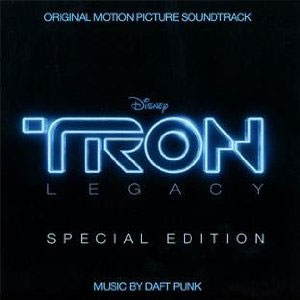
Daft Punk - Tron: Legacy Soundtrack

Sample the Album

If you're as far up the ass of Daft Punk as I am, then you're bound to think that their deep innards lead to some kind of kaleidoscopic dance floor heaven, populated by glamorous blue-skinned groovers. Being the divine French robots that they are, I felt that Guy-Manuel and Thomas could do no wrong. Their luminous dance music has had such a dynamic, satisfying and (most importantly) -fun- flair to it over the years, you never wanted to see it end. Unfortunately, it did. It turns out they are "human after all" to very much intend an awful, awful pun. The proof? Their score for Tron: Legacy.

Being an original film score, you already have a primer for visualization and emotion. At least, you think you would. While the score certainly does evoke a sinister science fiction universe, it doesn't bother to fill in the crucial details. "The Game Has Changed" is a perfect example of this. You can't really decide if you're in the world of Tron or of Inception (or The Dark Knight) until the excruciatingly curtailed synth chords plod in, almost an after-thought to the generic tornado of strings and foghorn brass. It's not as if the orchestral arrangements are just plain awful, but they are so painfully similar to half the blockbuster films that have come out in the last two years. At this point, there's a voice in your head and it begins repeating over and over, "so, basically they could have hired Bob the composer for 3/4 of this soundtrack, then left two songs to Daft Punk."

Sure, "Derezzed" and "End of the Line" offer Daft Punk swimming back to the thumping shores of analog funk, but honestly, it almost feels like an insult to see them included. After all, this is not the next Daft Punk album, it is a film score written by Daft Punk. So why even tease us? The real question is: were their musical sensibilities so incompatible with scoring a film that the duo couldn't find more of a distinctive or intriguing compromise? Generic scores are a cancerous growth on the ass of cinema - why not try pushing some boundaries? We know you have the talent for it, Daft Punk, we know you do. Instead, we just lose you, then find you, only to lose you all over again.

As it stands, Tron: Legacy is a mediocre film score created by an orchestra that just happened to feature two automatons with keyboards.